Your last SEO agency promised page one rankings in 90 days. Six months later, you’ve got nothing but a traffic report full of branded searches you were already getting.
Here’s what they didn’t tell you: 68% of online experiences begin with a search engine, which means your SEO partner controls the gateway to nearly seven out of ten potential customers (Source: Intergrowth 2024). When that partner doesn’t deliver, you’re not just wasting marketing budget. You’re haemorrhaging market share to competitors who got the hire right.
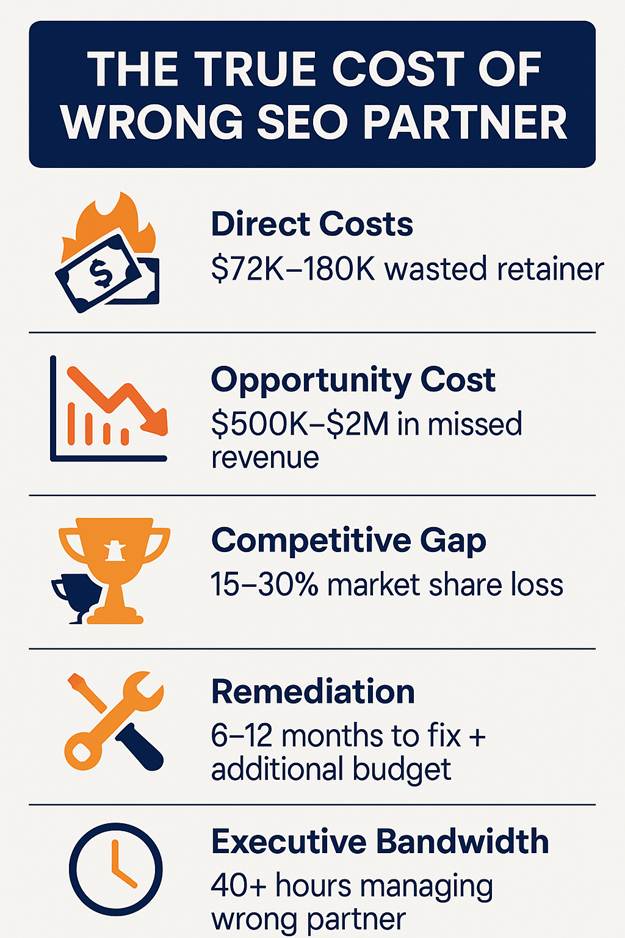
The average SEO retainer for mid-market companies runs $6,000-$15,000 monthly. Over a 12-month contract, that’s $72,000-$180,000 in capital allocation. Yet most C-suite executives spend more time vetting a mid-level hire than they do evaluating the agency that will drive their most profitable acquisition channel.
This isn’t another listicle of generic questions. This is a strategic framework for evaluating SEO service providers the same way you’d assess any critical business partnership: with focus on outcomes that matter to your P&L.
The Hidden Cost of Getting SEO Wrong
Let’s talk about what happens when executives treat SEO as a marketing line item instead of a strategic asset.
You sign with an agency that looks good on paper. Their case studies are impressive. Their sales team speaks your language. Three months in, you’re getting reports filled with metrics that sound important: “Domain Authority increased by 5 points.” “We built 47 backlinks this month.” “Keyword rankings improved for 23 terms.”
But your revenue from organic search hasn’t moved. Your customer acquisition cost from SEO is still higher than paid channels. And when you dig into those “improved rankings,” you discover they’re for terms nobody searches for.
The real damage isn’t the wasted retainer. It’s the opportunity cost.
While your competitors were capturing market share through effective SEO, you were generating reports. While they were building durable competitive moats through domain authority and content ecosystems, the gap between you and competitors who got this right compounds monthly.
Consider the iGaming operator who hired a generalist agency to handle their expansion into regulated markets. The agency applied standard link-building tactics without understanding gambling sector compliance requirements. Result: A Google manual action penalty that took eight months and $150,000 in remediation to resolve. During that period, their main competitor captured 23% additional market share in their target geography.
Or the fintech platform that chose an agency based on price point rather than expertise. The agency optimized for high-volume keywords without understanding the compliance and regulatory landscape of financial services. Traffic increased 340%, but qualified leads dropped 28% because the content attracted curiosity seekers, not potential customers.
These aren’t edge cases. They’re the predictable outcome of treating SEO vendor selection as a purchasing decision rather than a strategic partnership assessment.
The average CMO tenure is 40 months. If you waste 12 months with the wrong SEO partner, you’ve just consumed 30% of your window to demonstrate marketing ROI. In high-stakes sectors like gambling, blockchain, and fintech where Leverage specializes, that kind of delay can be existential.
Why Smart Executives Still Get This Wrong
The SEO industry has a transparency problem. Unlike other professional services where outcomes are clear and measurable, SEO exists in a fog of technical jargon, algorithm changes, and deliberately opaque reporting.
Myth #1: “All SEO Agencies Do the Same Thing”
This is like saying all lawyers do the same work because they all passed the bar. An agency that excels at local SEO for restaurants will destroy your international fintech brand. A team that crushes affiliate SEO for gambling comparison sites will trigger compliance nightmares if they apply those tactics to your brand casino.
The specialization matters more in SEO than almost any other professional service because the tactics, risk profiles, and success metrics are fundamentally different across sectors and business models.
Myth #2: “We Can Evaluate SEO Performance in 90 Days”
SEO is asset appreciation, not lead generation. When you invest in real estate, you don’t expect full ROI in quarter one. You expect the asset to appreciate over time while generating yield. The same framework applies to SEO.
According to HubSpot’s 2024 data, leads from SEO close at 14.6% compared to 1.7% for traditional outbound methods. But building the authority and content ecosystem to capture those high-intent searchers takes 6-9 months minimum. Agencies that promise faster results are either lying or using shortcuts that will backfire.
Myth #3: “More Links and Content Always Equals Better Results”
Quality trumps quantity in modern SEO by an exponential factor. One strategic piece of content that ranks for high-commercial-intent keywords will drive more revenue than 50 blog posts about tangentially related topics. One authoritative backlink from a tier-one industry publication carries more weight than 100 directory submissions.
Yet many agencies still sell SEO by volume because it’s easier to demonstrate activity than outcomes. They’ll show you dashboards full of content published and links built, while your actual business metrics remain flat.
The Due Diligence Gap
Most executives evaluate SEO agencies during a 2-3 call sales process. They review a handful of case studies. They check a few references. Then they sign a 12-24 month contract worth six figures.
Compare that to how you’d evaluate a head of sales or VP of product. You’d conduct multiple rounds of interviews. You’d assess strategic thinking through case presentations. You’d reference-check thoroughly with back-channel calls. You’d negotiate clear performance metrics and accountability structures.
The same should apply to your SEO partner selection. This agency will control a primary driver of your company’s growth and brand reputation. They’ll have access to your website, your competitors’ strategies, and your market intelligence. They’ll make technical decisions that could take months to unwind if wrong.
You’re not buying a service. You’re choosing a strategic partner who will either accelerate or derail your growth trajectory.
The Strategic Framework: 11 Questions That Separate Partners from Vendors
The questions that follow aren’t designed to test SEO knowledge. You can hire technical expertise. These questions assess strategic thinking, business alignment, and the operational capabilities that determine whether an agency becomes a growth multiplier or an expensive distraction.
We’ve organized them into three categories that mirror how you’d evaluate any mission-critical business partnership: Strategic Fit, Operational Engine, and Accountability Framework.
Part 1: The Strategic Fit (Questions 1-4)
These questions determine whether the agency understands your business model, market dynamics, and growth objectives well enough to function as a true strategic partner.
Question 1: “How would you describe our business model, and which aspects of it create unique SEO challenges or opportunities?”
What you’re really asking: Do they understand our business, or are they just selling a standardized service?
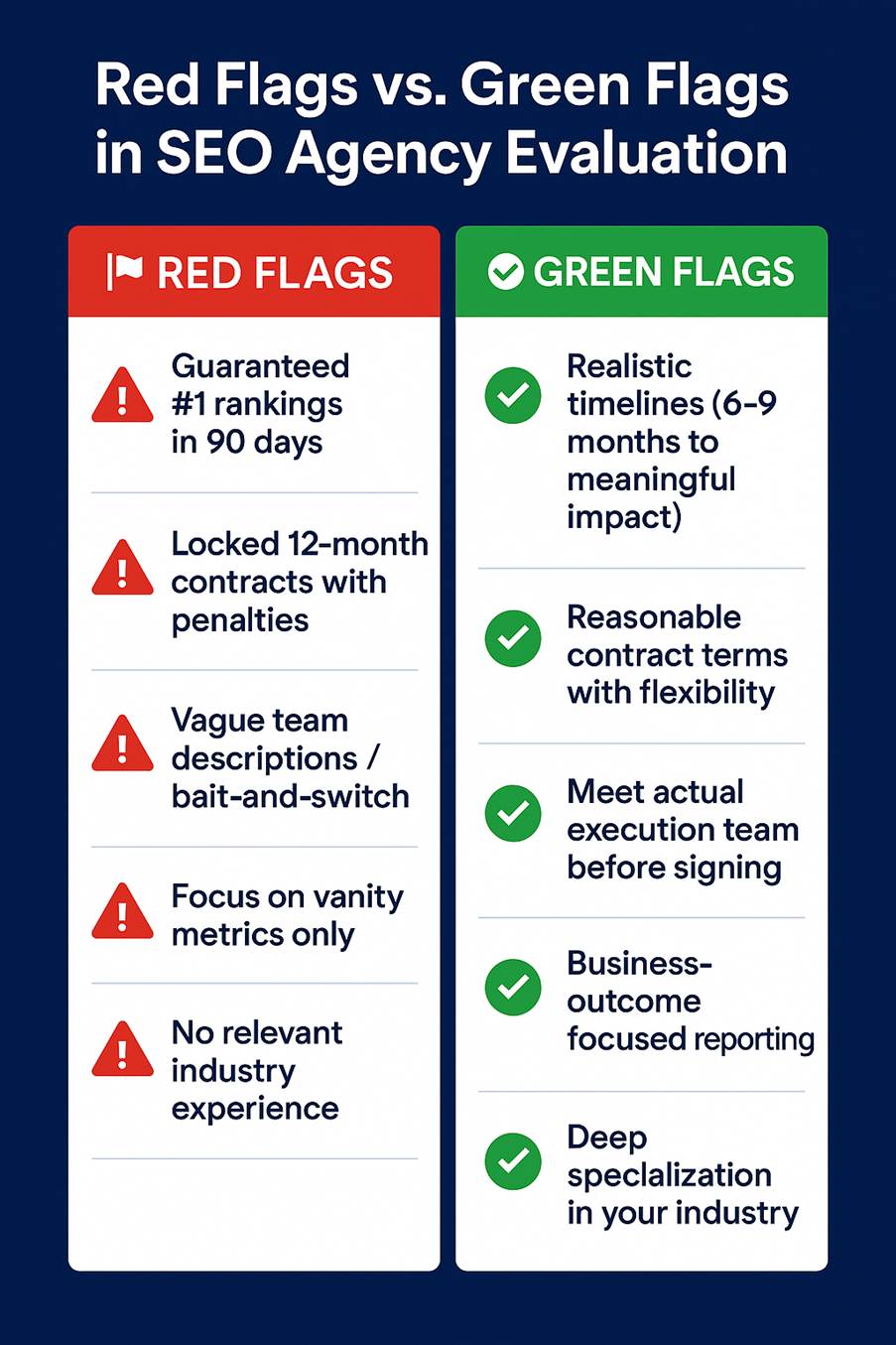
Red flag responses:
- Generic observations that could apply to any company in your sector
- Immediate jumping to tactics without understanding strategy
- No mention of your specific competitive landscape or market positioning
Green flag responses:
- Specific insights about your business model’s SEO implications (e.g., “As a B2B SaaS platform with a long sales cycle, your SEO strategy should focus on building authority for high-commercial-intent keywords while creating educational content that nurtures prospects through a 6-9 month consideration period.”)
- Questions about your unit economics, customer lifetime value, and ideal customer acquisition cost from organic channels
- Recognition of industry-specific challenges (compliance requirements in fintech, age verification in iGaming, technical complexity in blockchain)
When Leverage evaluates an iGaming client, we don’t start with keyword research. We start by understanding their licensing jurisdiction, payment provider limitations, target player demographics, and regulatory red lines. An agency that doesn’t ask these questions will optimize for metrics that don’t align with your actual business constraints and opportunities.
Question 2: “What SEO strategy would you recommend for a company at our stage and in our competitive position, and why?”
What you’re really asking: Can they think strategically about our specific situation, or do they apply the same playbook to everyone?
This question reveals whether an agency understands that SEO strategy must align with business stage. A well-funded Series B startup entering an established market needs a dramatically different approach than a profitable bootstrapped company defending market leadership.
Red flag responses:
- The same generic strategy they’d recommend to any company (“We’ll do technical SEO, content marketing, and link building”)
- No acknowledgment of your competitive position or market dynamics
- Tactics without strategic rationale
Green flag responses:
- Different strategies based on different scenarios (e.g., “If you’re the market leader, we’d recommend a defensive strategy protecting your brand terms and category leadership while expanding into adjacent markets. If you’re the challenger, we’d target competitor brand + alternative searches and underserved long-tail opportunities where incumbents aren’t competing.”)
- Discussion of resource allocation based on expected ROI timeline
- Recognition of trade-offs (e.g., “Aggressive content velocity might drive traffic faster, but could dilute your brand authority. Here’s how we’d balance these considerations…”)
Question 3: “Walk me through how SEO insights would inform decisions beyond marketing—product development, market expansion, or business strategy.”
What you’re really asking: Do they see SEO as a source of business intelligence, or just a lead generation channel?
This question separates tactical agencies from strategic partners. Search data provides unfiltered voice-of-customer insights. Keyword research reveals unmet market needs. Competitor content analysis exposes positioning gaps and opportunities.
Red flag responses:
- Confusion about why you’re asking (suggesting they see SEO as a marketing silo)
- Only discussing how SEO supports marketing goals
- No concrete examples of how search data informed business decisions
Green flag responses:
- Examples of how keyword research revealed product opportunities (e.g., “Our analysis for a fintech client revealed 15,000 monthly searches for ‘[competitor] alternative for small businesses.’ This search volume proved market demand for a SMB-focused product tier, which they launched and captured 23% of that search volume within 8 months.”)
- Discussion of how competitor content analysis reveals market positioning opportunities
- Frameworks for translating search data into actionable business intelligence
49% of marketers report that organic search has the best ROI of any marketing channel (Source: Search Engine Journal 2024). But the most sophisticated executives recognize that SEO’s value extends beyond customer acquisition into market intelligence, competitive analysis, and product validation.
Question 4: “How do you determine the appropriate budget and resource allocation for SEO relative to other growth channels?”
What you’re really asking: Do they think like a business advisor or a vendor trying to maximize contract size?
This question tests whether an agency can advise on capital allocation strategy, not just sell their services. A true partner should be able to articulate scenarios where SEO isn’t the right priority, or where budget would be better invested in paid channels, conversion optimization, or product development.
Red flag responses:
- Immediate pitch for their maximum service tier
- Inability to articulate scenarios where less SEO investment might be appropriate
- No framework for measuring opportunity cost against other channels
Green flag responses:
- Questions about your current customer acquisition cost by channel, conversion rates, and customer lifetime value
- Framework for calculating potential SEO ROI based on market search volume and current competitive positioning
- Honest assessment of whether SEO is the highest-leverage investment right now (e.g., “Based on your market position and search volume, you’d see faster ROI from conversion optimization for the next 6 months while we build your SEO foundation in parallel.”)
| Evaluation Criteria | Vendor Mindset | Partner Mindset |
| Business Understanding | Surface-level industry knowledge | Deep grasp of your specific business model and constraints |
| Strategy Customization | One-size-fits-all playbook | Tailored approach based on competitive position and resources |
| Scope of Impact | SEO drives marketing metrics | SEO informs business strategy and product decisions |
| Budget Guidance | Maximize contract value | Optimize capital allocation across channels |
| Success Definition | Rankings and traffic | Revenue, market share, and CAC improvement |
Part 2: The Operational Engine (Questions 5-8)
Strategic alignment means nothing without operational excellence. These questions assess whether an agency has the systems, processes, and talent to execute at the level required for meaningful business impact.
Question 5: “Who exactly will be working on our account day-to-day, what are their specific areas of expertise, and what’s their track record in our industry?”
What you’re really asking: Am I buying access to the A-team that sold me, or am I getting handed off to junior staff?
The bait-and-switch is endemic in agency services. The senior strategist leads the pitch. Then you’re handed off to junior account managers and freelance writers who’ve never worked in your industry.
Red flag responses:
- Vague descriptions of “our team” without specific names and backgrounds
- Resistance to introducing the actual execution team before contract signing
- Junior staff with no relevant industry experience
- High team turnover mentioned casually
Green flag responses:
- Specific names, backgrounds, and areas of deep expertise
- Offer to meet the execution team during the evaluation process
- Evidence of relevant industry experience (e.g., “Your technical SEO lead is Sarah Chen, who previously ran SEO for a $50M ARR fintech platform and specializes in compliance-friendly optimization for regulated industries.”)
- Clear description of team stability and continuity
At Leverage, founders Yonit Shvinkelstain and Elad Barzilai are directly involved in strategy for every client. We don’t pitch expertise we don’t deliver. When you work with us on iGaming SEO, you’re getting 20+ years of combined experience in online gambling, not an account manager reading from a playbook.
Question 6: “Describe your link-building philosophy and show me examples of the types of sites where you’ve secured links for clients in our industry.”
What you’re really asking: Are you going to get us penalized with sketchy link schemes?
Link building remains one of the powerful but risky aspects of SEO. The wrong approach can trigger Google penalties that take months to resolve. The right approach builds durable competitive moats.
Red flag responses:
- Guarantees about specific numbers of links per month (suggests bulk, low-quality approach)
- Vague language about “white-hat” practices without concrete examples
- Examples of links from obvious spam sites, irrelevant directories, or paid link networks
- No discussion of link quality assessment criteria
Green flag responses:
- Philosophy focused on editorial links from authoritative, relevant publications
- Specific examples of links secured, with explanations of why those publications matter in your industry
- Discussion of their content creation and outreach process
- Framework for evaluating link quality (domain authority, relevance, traffic, editorial standards)
- Honest acknowledgment of what’s not possible (e.g., “We can’t guarantee links from tier-one publications like Forbes or TechCrunch because those require extraordinary content. But here’s our tier-two strategy…”)
For gambling and fintech clients where Leverage specializes, link building requires extraordinary care. A single link from a questionable source can trigger compliance reviews or Google penalties. We maintain curated lists of pre-vetted publications and have editorial relationships that take years to build.
Question 7: “What’s your content creation process, and how do you ensure content quality and strategic alignment?”
What you’re really asking: Will you churn out generic AI content, or create strategic assets that actually drive business results?
The content marketing industry is drowning in generic, AI-generated mediocrity. Most agency content processes are optimized for volume, not impact. They’ll produce 20 blog posts monthly that rank for nothing and convert nobody.
Red flag responses:
- Emphasis on content volume over strategy
- No mention of subject matter expertise or editorial standards
- Generic writing samples that could apply to any company
- No process for ensuring content accuracy, especially in regulated industries
Green flag responses:
- Strategic content planning process tied to specific business objectives and customer journey stages
- Editorial standards and quality control processes
- Examples of content that demonstrates deep industry expertise
- Discussion of how they handle technical accuracy in complex industries
- Process for incorporating customer insights, sales team feedback, and product knowledge
Question 8: “How do you stay current with algorithm changes and industry best practices, and how quickly can you adapt our strategy when changes occur?”
What you’re really asking: Are you at the forefront of the industry, or are you following outdated playbooks?
Google makes thousands of algorithm updates annually. SEO best practices evolve continuously. An agency stuck in 2020 tactics will waste your budget on strategies that no longer work.
Red flag responses:
- Vague references to “staying up to date”
- No specific examples of how they adapted client strategies to recent algorithm changes
- Overconfidence that algorithm changes don’t affect their approach (suggesting they’re not sophisticated enough to be impacted)
Green flag responses:
- Specific examples of recent algorithm updates and how they modified client strategies in response
- Participation in industry organizations, conferences, and testing groups
- Process for monitoring algorithm changes and communicating impacts to clients
- Evidence of thought leadership (original research, speaking engagements, published insights)
Part 3: The Accountability Framework (Questions 9-11)
This is where most executives fail in their due diligence. They accept vague promises and generic metrics instead of establishing clear accountability structures that align incentives with outcomes.
Question 9: “What metrics will you report on, and which of those metrics directly correlate with our business objectives?”
What you’re really asking: Will you report on vanity metrics, or outcomes that actually matter to our business?
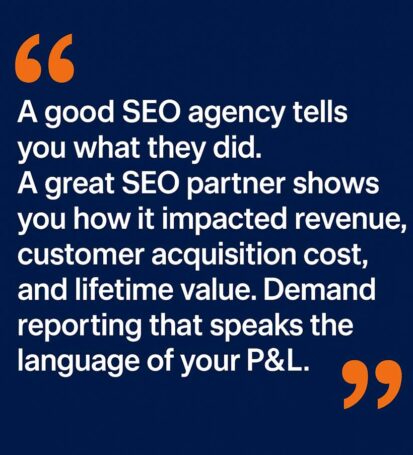
Most SEO reporting is designed to demonstrate activity, not impact. Agencies will flood you with keyword rankings, backlink counts, and “domain authority scores”—metrics that may or may not correlate with revenue.
Red flag responses:
- Long lists of SEO-specific metrics without business context
- Resistance to reporting on revenue or conversion metrics
- Metrics that are easily gamed (e.g., rankings for branded terms, traffic from irrelevant keywords)
- No discussion of benchmark goals or what success looks like
Green flag responses:
- Primary focus on business metrics: organic revenue, customer acquisition cost from SEO, qualified lead generation, conversion rates
- Secondary metrics clearly linked to business outcomes (e.g., “We’ll track rankings for these 50 high-commercial-intent keywords because analysis shows they drive 70% of qualified demos”)
- Benchmarking against your paid channel performance and industry standards
- Clear explanation of leading indicators (metrics that predict future business impact)
At Leverage, we structure reporting around three tiers:
- Business Impact: Revenue from organic, CAC from SEO, contribution to pipeline
- Strategic Metrics: Market share of high-value search terms, competitive position
- Operational Metrics: Content performance, technical health, link acquisition
We report both tier-three and tier-one outcomes.
Question 10: “Describe a time when your strategy wasn’t working and what you did about it.”
What you’re really asking: How do you handle adversity, and will you be transparent with me when things aren’t going according to plan?
This question is pure gold. Agencies that are honest about challenges and course corrections are infinitely more valuable than those that pretend everything always works perfectly.
Red flag responses:
- Claims that their strategies always work
- Blaming clients for failures (“They didn’t implement our recommendations”)
- Inability to articulate specific examples of adaptation
- Defensiveness about the question
Green flag responses:
- Specific examples of challenges with honest assessment of what went wrong
- Clear description of how they diagnosed the issue and adapted strategy
- Evidence of proactive communication with clients during difficult periods
- Learning outcomes that improved their approach for future clients
Question 11: “What would cause you to recommend we don’t work together?”
What you’re really asking: Are you so desperate for clients that you’ll take on engagements where you can’t deliver results?
This question tests integrity. A great agency will turn down clients where they can’t deliver value. They’ll be honest about limitations, competitive challenges, or misalignments that would make the partnership unsuccessful.
Red flag responses:
- “We can help any company” or inability to articulate scenarios where they’d decline
- Dismissive of potential challenges or competitive obstacles
- Focus solely on getting the contract signed
Green flag responses:
- Clear articulation of scenarios where they’re not the right fit (e.g., “If your primary goal is local SEO for physical locations, we’re not the right partner. Our expertise is in complex, technical SEO for digital products and services.”)
- Honest assessment of challenges in your market (e.g., “The competitive landscape in your category is extraordinarily difficult. Breaking into page one for commercial terms would require 18-24 months and significant content investment. If you need faster results, you should prioritize paid channels.”)
- Questions to understand whether expectations align with reality
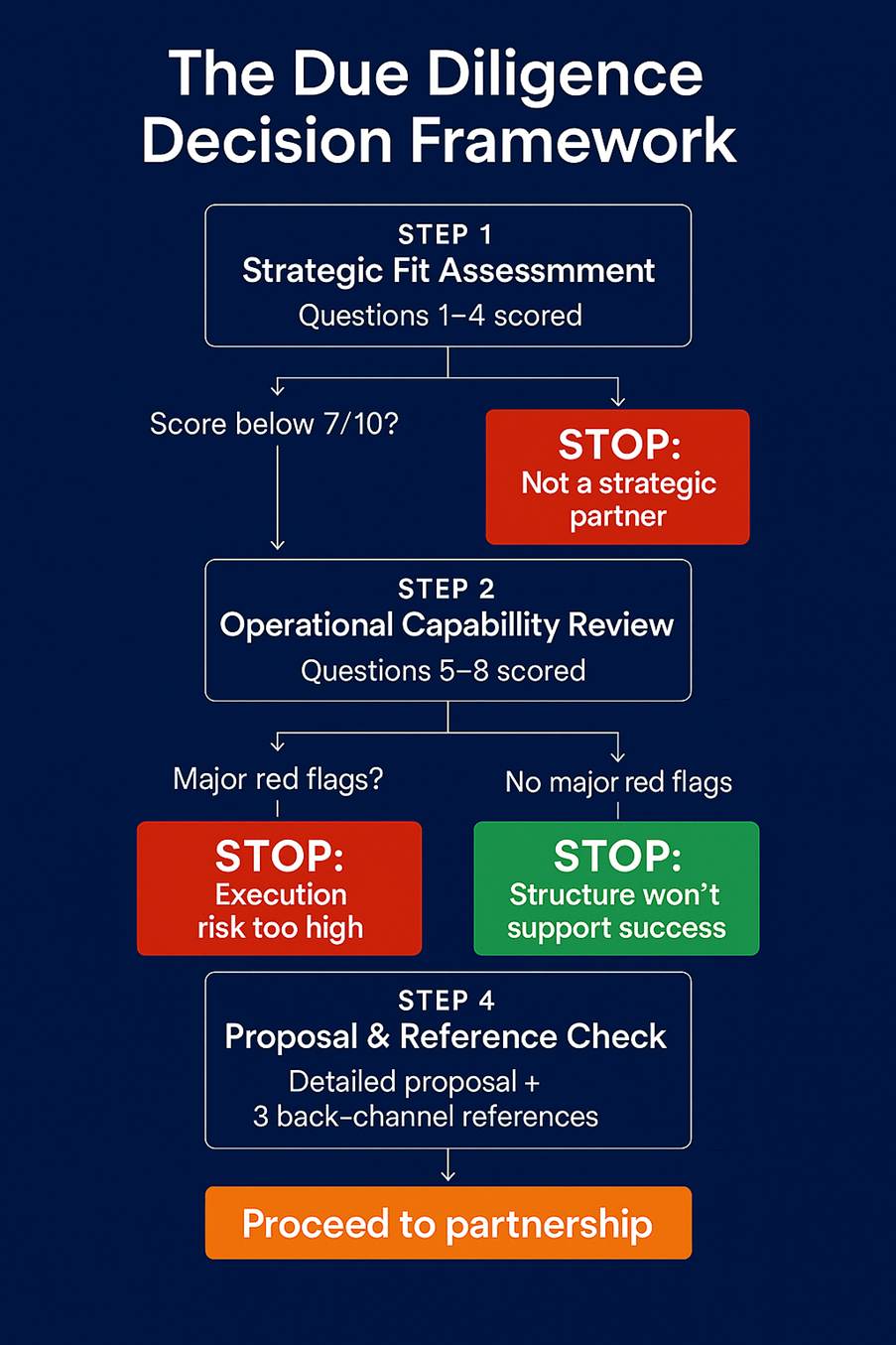
The Due Diligence Checklist: Your Decision Framework
Transform these questions into a structured evaluation tool. Rate each agency on a 1-10 scale across all 11 questions, with these benchmarks:
Strategic Fit (Questions 1-4):
- 9-10: Deep business understanding, strategic thinking that extends beyond SEO
- 7-8: Good grasp of business model, competent strategic planning
- 5-6: Surface understanding, mostly tactical focus
- Below 5: Generic approach, no evidence of strategic capability
Operational Engine (Questions 5-8):
- 9-10: Proven expertise in your industry, transparent processes, demonstrated quality
- 7-8: Solid capabilities, relevant experience, clear methodologies
- 5-6: Adequate systems but limited industry-specific expertise
- Below 5: Concerning gaps in process, team, or quality control
Accountability Framework (Questions 9-11):
- 9-10: Business-outcome focused, transparent, reasonable terms, high integrity
- 7-8: Good reporting structure, fair contracts, professional approach
- 5-6: Metric-focused but limited business connection, standard contracts
- Below 5: Vanity metrics, problematic terms, concerning red flags
Decision Thresholds:
- Total Score 32+ (Average 8+): Strong candidate – proceed to proposal and reference checks
- Total Score 24-31 (Average 6-8): Adequate but not exceptional – compare alternatives
- Total Score Below 24 (Average below 6): Significant concerns – likely not the right partner
Key Takeaways
If you take nothing else from this article, remember:
- Treat SEO Selection Like Executive Hiring: You’re choosing a strategic partner who will control a primary growth channel. Apply the same rigor you’d use for a VP-level hire, including multiple rounds of evaluation and thorough reference checking.
- Specialization Trumps Scale: An agency with deep expertise in your specific industry (iGaming, fintech, blockchain) will deliver exponentially better results than a large generalist firm. Domain knowledge determines whether tactics are compliant, effective, and aligned with your business model.
- Strategy Before Tactics: Agencies that jump immediately into execution without understanding your business model, competitive position, and growth objectives will optimize for the wrong outcomes. Demand strategic thinking before tactics.
- Business Metrics Over SEO Metrics: Traffic and rankings matter only if they drive revenue, reduce customer acquisition cost, or increase market share. Insist on reporting that connects to your P&L, not vanity metrics designed to demonstrate activity.
- Meet the Execution Team: The strategist who pitches you won’t be doing the day-to-day work. Demand to meet the actual team who will execute your strategy before signing, and verify their relevant experience.
- Integrity Under Pressure Matters Most: How an agency handles challenges, admits limitations, and adapts strategy when results lag expectations determines whether they’re a true partner or just a vendor protecting their retainer.
The Stakes: Why This Decision Matters More Than You Think
Let’s quantify what’s at stake in this decision.
Over a three-year strategic horizon, the cumulative impact of getting SEO right versus wrong is $1.5M to $6M in revenue difference.
But the financial impact extends beyond direct revenue:
Customer Acquisition Economics: Leads from SEO close at 14.6% compared to 1.7% for traditional outbound (Source: HubSpot 2024). If your average customer lifetime value is $50K and you’re acquiring 100 customers monthly through various channels, shifting even 20% of that volume to SEO could reduce your blended CAC by 40-50%. At scale, that’s millions in improved unit economics.
Competitive Positioning: Search engine rankings are zero-sum in the near term. Every position your competitors occupy on page one is a position you don’t. In winner-take-most markets like iGaming, fintech, and SaaS, the companies that dominate page one for commercial keywords capture disproportionate market share. Being six months behind in SEO strategy can translate to permanent market share loss.
Asset Appreciation: Unlike paid advertising where ROI stops the moment you stop spending, SEO builds compounding assets. Quality content and domain authority appreciate over time. A $100K investment in SEO in year one might generate $150K in year one revenue, but $400K in year three from that same content as it matures and ranks for more terms. The agency you choose determines whether you’re building these durable assets or renting temporary traffic.
Executive Reputation: As a CMO, VP of Marketing, or CEO, your SEO agency selection becomes part of your track record. A successful partnership that drives measurable growth enhances your reputation and demonstrates strategic acumen. A failed engagement that wastes budget and opportunity becomes a data point against your judgment in future performance reviews or job searches.
The timeline matters too. The average CMO tenure is 40 months. If you waste 12 months with the wrong agency, discover the problems, and spend another 6 months in transition, you’ve consumed nearly 50% of your tenure building toward results. You need to get this decision right the first time.
You now have the framework to get this right.
And here’s the question worth asking yourself: Based on what you’ve read in this article, does your current SEO approach—whether in-house or with an existing agency—meet the standard we’ve outlined? Are you treating SEO as a strategic asset with appropriate oversight and accountability, or as a marketing line item that gets reviewed quarterly at best?
If you’re starting a vendor evaluation process or reassessing your current SEO partnership, we’d be happy to offer a complimentary 30-minute SEO Consultation. No sales pitch, just a strategic conversation about your specific situation, the SEO opportunities in your market, and honest guidance on what would actually move the needle for your business.
We specialize in complex, high-regulation sectors where most agencies fear to tread: iGaming, Web3 platforms, fintech, and emerging market expansion. If you’re in one of these spaces and tired of generalist agencies that don’t understand your constraints and opportunities, let’s talk.
Schedule your complimentary SEO Growth Consultation: Contact Leverage